
One loop, every hour, on every product.
Roasy connects your Google Ads account, your shop and its live traffic, then re-prices each product every hour inside limits you set. Here is what happens, what it needs, and what is live today.
Your shop knows more than Google. Thirty seconds, with sound; figures are examples.
The hourly loop
The first version of Roasy ran once an hour at 23 minutes past and waited on Analytics. This one reads Google Ads about an hour after the clicks happen, sees your shop within the minute, and reacts between runs when something can’t wait.
- CollectClicks, cost and conversions per ad group and product from Google Ads, and live visits, baskets and orders from Roasy Pulse.
- ScoreEach product’s likely conversion rate, order value and margin for this hour of this day.
- Work out a bidYour rules run first. Prediction fills in where no rule applies, or nudges a rule’s answer within limits you set.
- Safety checksMinimum and maximum bid, the catch-all floor, the biggest step allowed, budget pace and Google’s daily API allowance.
- WriteOnly bids that changed by a meaningful amount go to Google Ads, batched per campaign. A run takes seconds.
- Log and measureBefore and after, the reason, the inputs it saw and, a day later, what happened next.
Roasy Pulse: your shop, live
Google Analytics 4 can’t drive hourly bidding on its own: its real-time view covers 30 minutes with no product detail, and its reports take a day or two to settle. Pulse fills the gap.
- The click carries its own labels. A URL suffix adds the campaign, ad group and product to every landing page, so Pulse knows which ad brought each visit.
- A 7 KB script, no libraries. Page views, product views, baskets and checkouts, loaded after your page.
- Orders from your shop, not the browser. Pulled from your shop every few minutes, so ad blockers and closed tabs don’t lose sales.
- Private by design. No IP addresses stored; the Google click id kept only with the shopper’s marketing consent.
Live now. Roasy 2: sales sent back to Google Ads as profit through Google’s Data Manager API, so Google’s own systems learn from your true value.
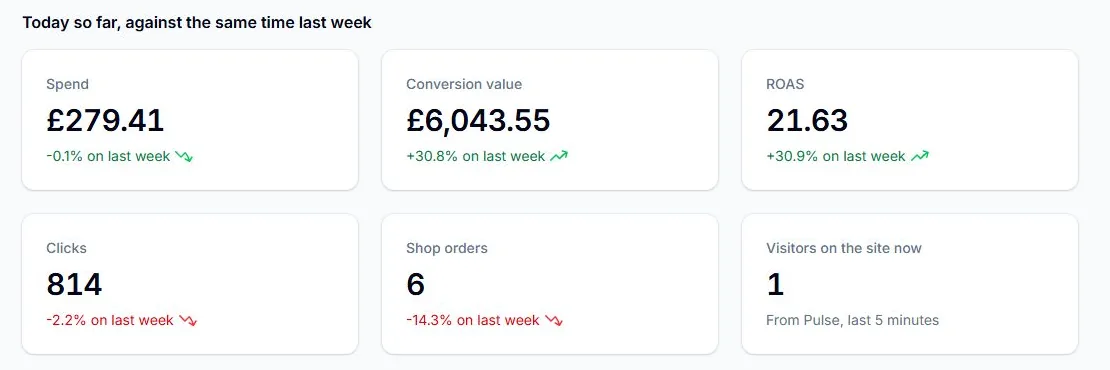
The Today page, sample data: today so far against the same time last week.
Prediction you can read
For every product, Roasy estimates what a click is worth right now, and shows the inputs it used. Plain maths, refitted nightly, so you can see why it thinks what it thinks.
- Recent sales count most, with older history fading out.
- Thin data borrows strength from the product’s tier or the whole account, instead of guessing wildly.
- Profit-aware when your shop holds cost prices.
- An hour-of-day curve, so evenings and lunchtimes are priced differently.
- A small exploration allowance, so new products get a fair chance to prove themselves.
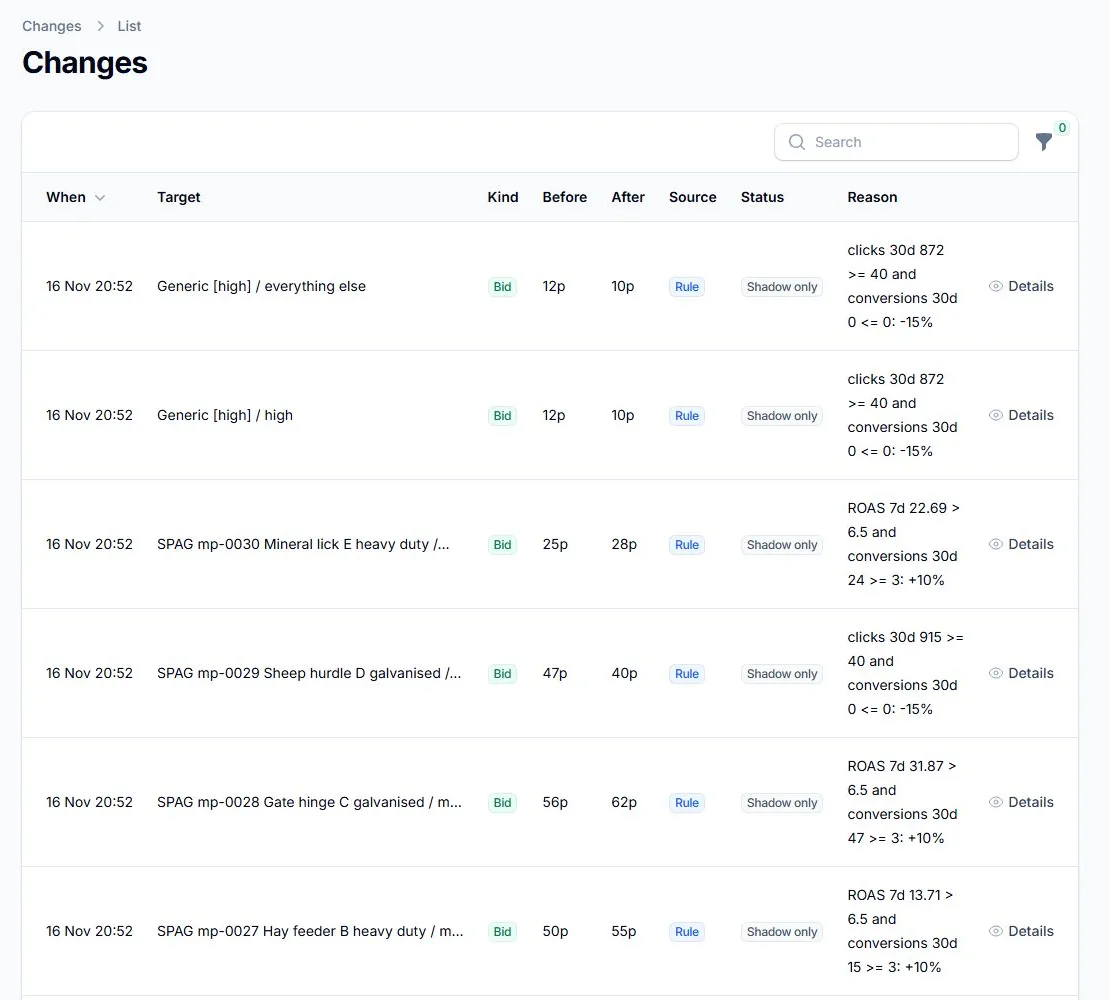
Every proposed change, with the rule or prediction behind it. Sample data.
A structure built for control
Roasy builds and keeps the set-up that lets each product compete on its own terms: one ad group per product, with cheap catch-all campaigns underneath for everything else.
- Negatives follow the tier. A search that wastes money on one product drops to the catch-all at the floor bid. Only a search that wastes money across the whole account is blocked outright.
- Tiers move with the data. A product that starts selling moves up into a better-funded catch-all.
- Non-converters are paused, not bid down, and proposed for your approval first.
- Your hand edits win. Remove a negative by hand and Roasy never adds it back.
A search with 50 clicks and no sale on one product drops down
200 clicks and no sale across the account: blocked outright
Example values. In Roasy the tiers, floors and thresholds are settings, not code.
Guardrails, approvals and three modes
Every change Roasy wants to make passes one set of checks. Small changes inside your limits go straight through and are logged. Anything bigger waits in an approval inbox.
Shadow, Approve, Live
New accounts start in Shadow: Roasy logs every bid it would make and writes nothing. Approve sends everything to the inbox. Live writes inside your guardrails. A kill switch stops all writes at once.
Limits you set
Whole pence, minimum and maximum bids, the catch-all floor, the largest step, the minimum move worth writing, changes per day, a cool-down, do-not-touch lists and trading hours.
An anomaly stop
In Live mode, a run that would move more than 30% of your bids stops and asks a person first.
Undo, properly
Revert one change or a whole run from the Changes log. Every sign-in and change is in the audit log.
What arrives in Roasy 2
Roasy is in early access. These are being built now, in this order, each one finished before the next starts.
Feed studio
Rewrites product titles and descriptions with the words people search, then tests each change against a matched control group for two to four weeks. Your shop’s own feed is never touched.
Search Console and GA4 history
Seasonality, last year’s same weeks and the search words that land on each product page, feeding prediction and titles.
Sales back to Google as profit
With the shopper’s consent, each sale goes back to Google Ads with its click id, optionally as margin rather than revenue.
A strategist you can talk to
An AI agent inside Roasy that plans campaigns, audits the structure, explains why a bid moved and drafts the weekly review. Agents propose; Roasy still enforces your limits.
An hourly pilot
A small agent that reads each run’s summary and can hold a change for something the rules can’t see, like a promotion or a delivery cut-off, writing down why.
Client views
A read-only dashboard for each retailer, so agencies can share results without sharing the controls.
What Roasy needs from you

See what Roasy would do with your account, before it does anything.
Tell us about your shop. We check your Shopping set-up first, free, and tell you honestly whether Roasy is a fit.